The Global Gold Price Surge in 2025: Factors, Trends, and Future Outlook
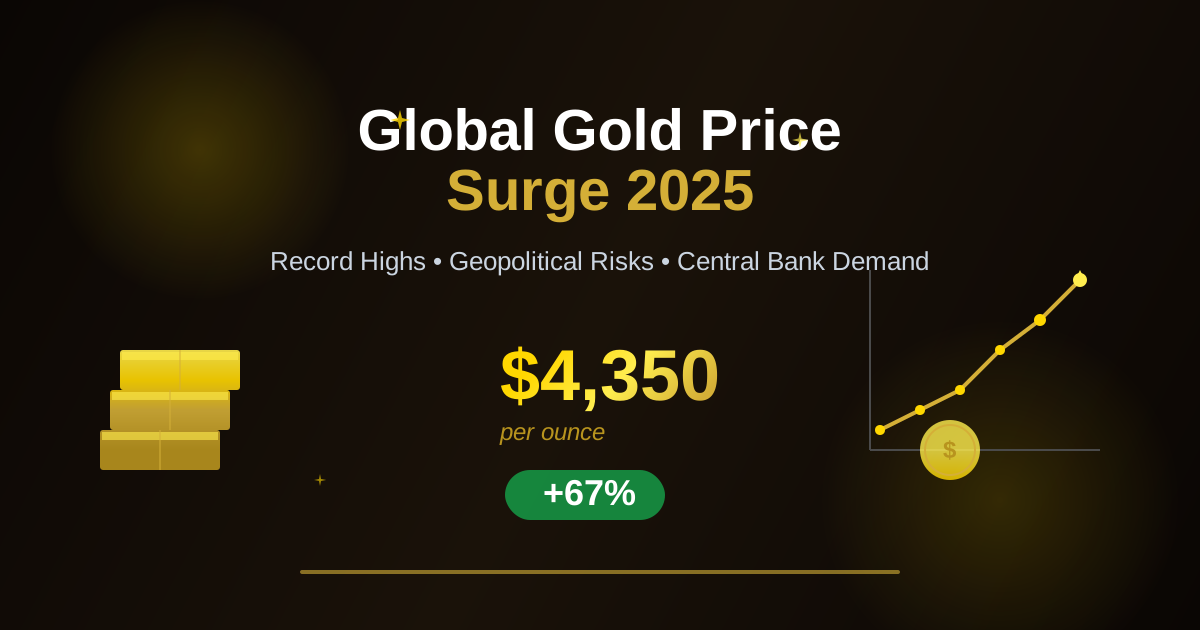
2025 has been a landmark year for gold, with prices surging to unprecedented levels, climbing over 60% year-to-date and repeatedly setting new all-time highs. As of December 2025, gold is trading around $4,350 per ounce, marking its strongest annual performance since 1979. This dramatic rise reflects a perfect storm of geopolitical risks, economic uncertainties, central bank buying, and a weakening US dollar. Investors worldwide have flocked to gold as a safe-haven asset, driving demand to record levels. In this article, we delve into the key drivers behind this surge, current trends, and what the future might hold for the yellow metal.
Current Gold Prices and Historical Context
Gold's price trajectory in 2025 has been nothing short of extraordinary. Starting the year at around $2,600 per ounce, it surpassed $4,000 in October and peaked near $4,370 in mid-December. This represents a 67% increase, outpacing most major asset classes and cementing gold's status as a top performer amid global volatility.
Historically, gold thrives during periods of uncertainty. The last comparable surge was in 1979, driven by high inflation and oil crises. Today, similar factors are at play, but amplified by modern geopolitical dynamics and post-pandemic economic shifts. For context, gold's share of global financial assets has risen to about 2.8% in Q3 2025, up from previous years, highlighting its growing role in portfolios.
Key Factors Driving the 2025 Gold Price Surge
Several interconnected factors have fueled gold's remarkable ascent:
1. Geopolitical Tensions and Global Uncertainty
Heightened geopolitical risks have been a primary catalyst. Ongoing conflicts, such as the Russia-Ukraine war and tensions in the Middle East, have boosted demand for safe-haven assets. For instance, Russian President Vladimir Putin's territorial demands and US actions against Venezuelan oil shipments have escalated fears. Additionally, US tariffs under the Trump administration have raised concerns about trade wars, supply chain disruptions, and inflation, accounting for roughly 16% of gold's price gains.
The Geopolitical Risk (GPR) Index spiked in 2025, contributing significantly to gold's rally. Economic policy uncertainty, particularly around US tariffs and Federal Reserve independence, has driven nearly half of the price increase since late 2024.
2. Central Bank Buying and Reserve Diversification
Central banks have been voracious buyers, purchasing over 980 tonnes in Q3 alone—a 50% increase from recent averages. This trend, led by countries like China and India, reflects a shift away from the US dollar toward gold for reserve diversification. Surveys indicate central banks plan to increase gold holdings further, viewing it as a hedge against currency debasement and inflation.
3. Economic Factors: Inflation, Interest Rates, and Dollar Weakness
A weaker US dollar has made gold more affordable for international buyers, contributing about 7% to the rally. Expectations of Federal Reserve rate cuts amid moderating inflation have reduced the opportunity cost of holding non-yielding gold. Fresh US CPI data in December reinforced these bets, pushing prices higher.
Inflation expectations, though tempered, remain elevated due to potential tariff impacts, adding to gold's appeal as an inflation hedge.
4. Investor and Retail Demand
Institutional and retail investors have poured into gold via ETFs, futures, bars, and coins. Global demand hit 1,313 tonnes in Q3, with strong inflows from ETFs offsetting earlier outflows. Retail demand in China and other emerging markets surged, though jewelry demand dipped due to high prices. Positive momentum and AI-driven electronics demand have also supported the market.
Global Impacts of the Gold Surge
The price boom has ripple effects worldwide:
- Mining and Supply: Gold producers have benefited, but supply growth lags at 0.3% annually since 2018. Regulatory hurdles, environmental concerns, and higher costs could delay new projects, potentially exacerbating shortages.
- Emerging Markets: Countries like India and China, major consumers, face higher import costs, impacting jewelry and investment sectors.
- Financial Markets: Gold's rally has influenced broader markets, with correlations to equities and bonds shifting amid volatility.
- Technology Sector: Increased gold use in electronics, driven by AI adoption, adds to demand pressures.
Future Outlook: Will Gold Continue to Shine?
Analysts are optimistic but cautious. Goldman Sachs forecasts gold at $4,000 by mid-2026, with upside risks from continued central bank demand and Fed easing. J.P. Morgan sees potential for $7,000 long-term, while surveys predict $3,070 by end-2026. The World Gold Council highlights balanced drivers, suggesting sustained growth unless major rate hikes or dollar strength intervenes.
However, risks include overexuberance leading to pullbacks, as speculative positions are elevated. A bear case could emerge from resolved geopolitics or stronger economic growth reducing safe-haven appeal.
Conclusion: Gold's Enduring Appeal in Uncertain Times
The 2025 gold surge underscores its timeless role as a store of value amid chaos. With geopolitical tensions, economic shifts, and diversification trends persisting, gold's upward trajectory seems poised to continue into 2026. Investors should monitor key indicators like the US dollar, interest rates, and global events. As always, while gold offers protection, diversification remains key in any portfolio.
Proceed with caution: Markets are volatile, and past performance is not indicative of future results.